
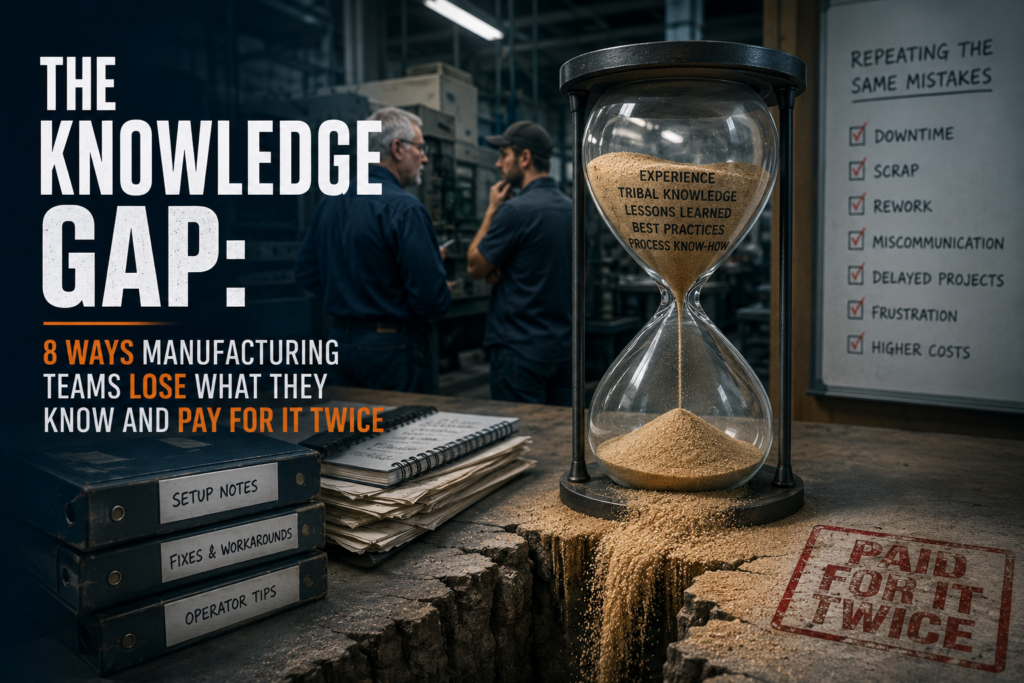
Every manufacturing operation runs on knowledge.
Not just data in systems. Not just procedures in binders. The real knowledge. The kind that tells you why Line 3 runs differently on humid days. The kind that knows which supplier always ships late on reorders. The kind that remembers the last time this exact failure mode showed up and what actually fixed it.
This knowledge exists in every plant. And in most plants, it is disappearing faster than anyone realizes.
It leaks out between shifts. It retires with your best people. It hides in spreadsheets only one person understands. It sits in closed-out reports nobody will ever open again.
The cost is not dramatic. It is steady. Repeated investigations. Missed customer requirements. Quotes built on memory instead of history. Decisions made without context that was available but unreachable.
Here are eight of the most common ways this knowledge gap costs manufacturers margin, and the shift that closes each one.
1. Lessons Learned That Nobody Revisits
Your team solved this exact problem 18 months ago. Different project. Different people. Same root cause. But nobody can find what was done last time.
A scrap spike shows up. The team investigates for two days, finds the fix, and production recovers. Six months later, same part, same failure mode, different shift. They start from scratch. Two more days of investigation. Two more days of lost output.
The lesson existed. It just lived in a closed-out report nobody will ever open again.
The shift: Stop filing lessons in folders and hoping someone searches for them. Surface past solutions automatically when a similar problem appears. Match current failure modes to historical fixes. Bring the answer to the team before they start the investigation.
The most expensive lesson is the one you already learned and paid for twice.
2. The Gap Between SOP and Practice
Your procedures say one thing. Your floor does another. Both versions “work” until an audit, a quality escape, or a customer complaint.
The answer is almost never negligence. It is drift. A workaround that solved a problem two years ago. A shortcut that saved time and nobody questioned. A step that stopped making sense but stayed in the document. Over time, the procedure and the practice quietly separate.
The SOP says one thing. The training says another. The floor does a third. Nobody notices until something breaks.
The shift: Stop writing procedures once and reviewing them annually. Capture how work is actually performed at the machine, compare it to the documented procedure, and surface the gaps before an auditor or a customer does.
The most dangerous process is the one everyone follows but nobody documented.
3. Training Decay
Your team was fully trained six months ago. Can they still do it right today?
Training happens once. Certification gets filed. Everyone moves on. But skills decay. The operator certified on a new process in January has not run it since March. The inspector who passed the refresher cannot remember the updated acceptance criteria.
Companies invest heavily in training events, then measure success by completion rate. 100% trained. Zero follow-up. The assumption is that trained means capable. Six months later, that assumption is costing you in scrap, rework, and inconsistency.
The shift: Stop assuming competence from a certificate. Assess understanding continuously. Connect training records to actual job performance so you can see where the gaps are forming before they show up as defects.
A training certificate proves someone learned it once. It does not prove they can still do it today.
4. What Gets Lost Between Shifts
What gets lost between shifts costs more than what gets built during them.
Second shift starts. The machine is down. Nobody knows why. First shift had it figured out. They made an adjustment, ran test parts, got production back on track. But the handoff was a sticky note, a verbal “heads up,” or nothing at all.
So second shift starts troubleshooting from scratch. An hour lost. Maybe two. Maybe a scrapped run before they realize the fix was already found. The knowledge transfers that matter most are the ones that happen fastest. End of shift, people are tired, critical context gets compressed into a sentence or skipped entirely.
The shift: Stop relying on verbal handoffs and logbooks. Capture shift context in structured, searchable records tied to the equipment and the job. Make it available instantly to whoever walks in next.
The best shift handoff is the one that does not depend on who remembered to give it.
5. Customer-Specific Requirements Living in Tribal Memory
One wrong spec shipped to the wrong customer and the relationship you spent years building is over.
Every customer has unique requirements. Special packaging for one. Tighter tolerances for another. A specific test report format for a third. None of it is in the ERP. Most of it is not in the quality system either. It lives in emails, in someone’s head, in a folder on a shared drive that three people know about.
A new operator runs the job, follows the standard work instruction, and everything looks right. But that customer needed an extra inspection step. Nobody told them. The part ships. The call comes in. The corrective action starts.
The shift: Stop storing customer requirements in tribal memory and scattered files. Capture every requirement in a structured system tied to the part number and the customer. Surface it automatically when the job is released.
The customer requirement nobody remembered is the one that costs you the account.
6. The Spreadsheet Layer
Your most critical decisions are running through files no system controls.
Every plant has them. The scheduling spreadsheet one planner maintains. The cost tracking workbook finance built three years ago. The supplier scorecard on someone’s desktop. The capacity model that only works if you know which tabs to ignore.
These are not minor tools. They are load-bearing infrastructure. And they have no version control, no audit trail, and no backup plan if the person who built them leaves.
Someone asks a question in a meeting. The answer comes from a spreadsheet nobody else has access to. Everyone nods. But that file was last updated two weeks ago, one formula references a deleted tab, and the data was pasted in from a system that has since been corrected. The decision was made. The foundation was wrong.
The shift: Stop letting critical business logic live in personal spreadsheets outside every system of record. Connect the data those spreadsheets are trying to organize. Make it queryable, live, and visible to everyone who needs it.
If your best decision tool is a spreadsheet only one person understands, it is not a tool. It is a risk.
7. Near-Miss Reporting
The event that almost caused a problem is the one that predicts the next one.
A tool slipped but nobody got hurt. A dimension came back at the edge of spec but still passed. A machine ran hot for 20 minutes before someone caught it. Nothing happened. So nothing got recorded.
Teams are trained to report incidents. Nobody reports the almost-incidents. Because there is no injury to log, no scrap to count, no customer complaint to respond to. So the near-miss disappears. And the conditions that created it stay in place. Until the next time, when the margin is not as forgiving.
The shift: Stop treating near-misses as non-events. Make reporting as simple as answering a few guided questions at the machine. Capture what almost happened, what conditions were present, and what prevented it from getting worse. When similar conditions appear across shifts, machines, or parts, connect them. One near-miss is easy to dismiss. Three with the same root condition is a prediction.
The cheapest problem to fix is the one that has not happened yet.
8. Decisions Made Without Historical Context
Your team is making decisions right now without seeing what happened last time. That is the most expensive kind of confidence.
A new project kicks off. The timeline looks reasonable. The budget feels right. But nobody checked how the last three similar projects actually landed. Two ran 30% over budget. One missed delivery by six weeks. All three had the same bottleneck in the same phase.
That information exists. It is sitting in closed-out project records, quality logs, and financial reports across multiple systems. Nobody has time to dig through all of it. So the team plans forward without looking back. The pattern repeats. The same surprises show up. The same margin gets lost.
The shift: Stop planning from assumptions and experience alone. Surface historical performance automatically when a new project, quote, or decision begins. Show what similar work actually cost, how long it actually took, and where it actually broke down. Before the first commitment is made.
Experience without data is a guess. Data without access is wasted. Both together is how you protect margin.
The Common Thread
Every one of these eight problems shares the same root cause.
Critical knowledge exists but it is trapped. In people’s heads, in disconnected systems, in spreadsheets nobody else can access, in reports nobody revisits, and in handoffs that depend on memory.
The old way is to compensate. Train harder. Document more. Hope the right person is on shift when it matters.
The new way is to capture knowledge structurally, connect it to the work it applies to, and surface it automatically at the moment it is needed.
That is what AIBI was built to do.
Not replace your people. Not add another system to manage. Just make sure that what your organization already knows is available to the people who need it, when they need it, every time.
Your expertise already exists. Your lessons have already been learned. Your history has already been recorded. The only thing missing is the connection between what you know and when you need to know it.
If any of these eight problems sound familiar, let’s talk. Not a sales pitch. A conversation about what knowledge your team is losing and what it would look like to keep it.
