
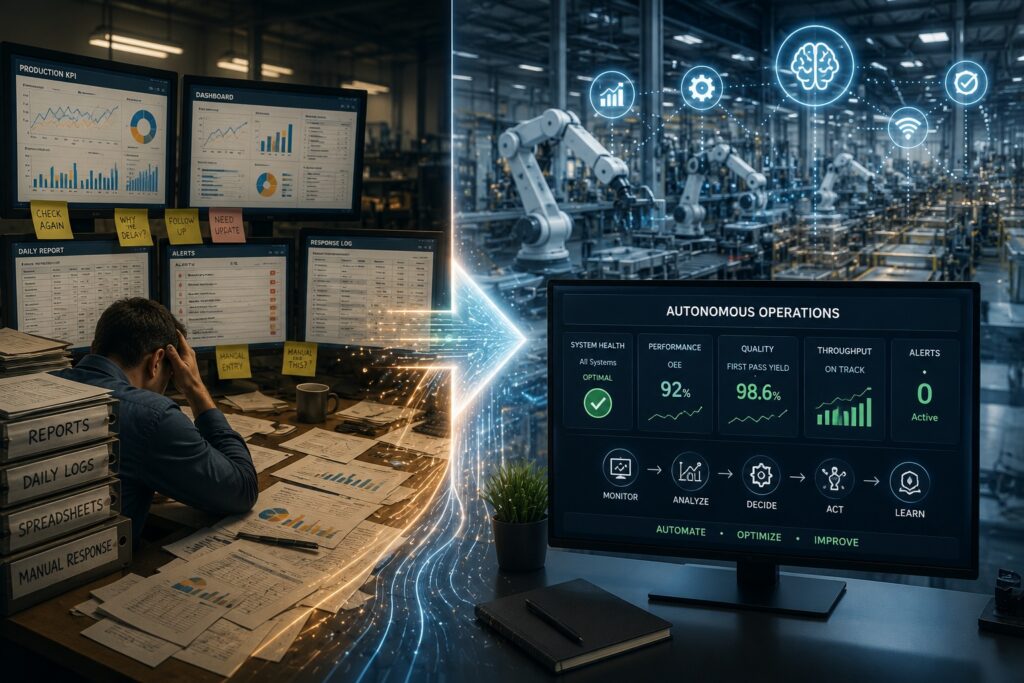
In the previous series, we made the case that dashboards and reports are old thinking.
They depend on humans watching the screen, reading the report, catching the anomaly, remembering the check. And humans, no matter how skilled, are the slowest, most expensive, and most fatigable part of any operation that tries to scale that model.
So the question is not whether the dashboard era is ending.
It is what replaces it.
The answer is not more dashboards. Not faster reports. Not bigger analytics teams. It is a different architecture entirely. Continuous monitoring. Codified response playbooks. AI agents that act on the data the moment it arrives. Humans handling exceptions, not vigilance.
This is autonomous operations. It is not theoretical. It is already being built. And the manufacturers who move first are competing on a cost structure their peers cannot match.
Here are eight ways autonomous operations replace the dashboard-and-report model, and the margin each one protects.
1. The Playbook Layer
Every experienced operator on your floor is carrying playbooks in their head. When they leave, the playbooks leave with them.
Watch your best supervisor for a day. When a machine starts running hot, they check the coolant flow, look at the last PM record, ask the operator if anything changed, and make a call. That sequence is a playbook. They did not invent it on the spot. They have run it a hundred times. It just lives in their head.
The most valuable knowledge in your operation is not in the SOP. It is in the response patterns your experts use when something goes wrong. What to check first. What to escalate. What to ignore. And in most operations, it exists nowhere except in the minds of the people who built it.
The shift: Stop treating expert response patterns as tacit knowledge. Capture the playbook explicitly. Codify what to check, what to do, and what to escalate. Let the system run it consistently across every shift, every machine, every operator.
Every expert has a playbook. The question is whether your operation has access to it when they are not in the building.
2. Monitoring + Playbook = Action
Detection without response is the most expensive kind of awareness.
Most “monitoring” tools stop at notification. The threshold is crossed. An email goes out. A flag appears on a dashboard. Then nothing happens. Because notification was never the goal. Action was. Monitoring alone is half a system. It tells you something is happening. It does not tell you what to do about it.
So your team improvises. Every time. Sometimes well. Sometimes badly. Always inconsistently.
The shift: Pair every monitored condition with a defined playbook. When the condition fires, the playbook runs. The agent gathers context, executes the response, opens the work order, assigns the owner, and only escalates when human judgment is required.
Monitoring tells you something happened. A playbook makes sure something gets done about it.
3. The Agent Does the First Mile
Every minute your team spends gathering context is a minute they are not making a decision.
A problem surfaces on the floor. Before anyone can act, the work begins. Pull the production data. Check the maintenance history. Look at recent quality records. Find out who was on shift. Check the supplier batch. By the time the context is gathered, an hour has passed. The decision still has not been made.
The expensive work is not the decision. It is everything that has to happen before the decision can be made. The judgment takes minutes. The preparation takes hours.
The shift: Let the agent do the first mile. When the condition fires, the agent gathers the data, pulls the history, identifies patterns, and presents the situation with full context. The human shows up to a decision-ready briefing.
Agents do not replace decisions. They eliminate every step before the decision.
4. Closed-Loop Operations
If every detection requires a new investigation, you are not running an operation. You are running an outage response.
Most operations run open loops. Something happens. Someone notices. A meeting is called. An investigation starts. A fix is implemented. The lesson is filed. And the loop never closes. The next time the same condition appears, the cycle starts over from scratch.
The fix that worked on Line 2 in March is not available to the team on Line 5 in September. The diagnostic that took two days the first time still takes two days the second time. Each incident is treated as new. Even when it is not.
The shift: Build the loop. Monitor continuously. Detect automatically. Respond from a playbook. Document the outcome inside the system. Use the result to refine the playbook for next time. The operation gets better with every incident.
An open loop fixes problems one at a time. A closed loop fixes the same problem one last time.
5. Exception Handling as a Job Role
When the system handles the routine, your people stop watching screens and start solving what only they can solve.
Most operations have their best people spending most of their time on work that should not require them. Pulling data. Generating reports. Reviewing alerts. Following up on routine checks. None of it requires their judgment. All of it eats their day. The strategic work that justifies their salary happens in the cracks.
The shift: Let the system handle the routine. Let agents run the playbooks. Let your people focus on exceptions, judgment calls, and the work that requires human reasoning. When the system handles the predictable, the role changes. Your senior engineer stops monitoring dashboards and becomes the person who handles the cases the playbook escalates. Your supervisor stops compiling shift reports and becomes the person who solves the problems the agent could not resolve.
Your best people should not be watching the operation. They should be improving it.
6. The Audit Trail of Autonomous Actions
Every automated action without an audit trail is a finding waiting to happen, and one failed audit can shut down your operation.
The first question every auditor asks about automated systems is the same. “Show me what it did.” In most early automation efforts, the answer is uncomfortable. The system ran. Something happened. We are pretty sure it worked.
The promise of autonomous operations only works if the proof goes with it. Otherwise compliance leaders block every initiative. Quality leads do not trust the results. Customers refuse to accept the data.
The shift: Treat documentation as part of the action itself. Every detection, every playbook step, every escalation, every resolution gets logged with full context. Time-stamped. Linked to the data. Reviewable on demand. Audit-ready by design, not audit-prepared by panic.
Autonomous operations without audit trails are not modern. They are reckless.
7. From Reactive to Predictive to Autonomous
Every quarter you stay reactive is a quarter your competitors are preventing the problems you are still fighting.
There is a maturity curve in operations. Reactive. Predictive. Autonomous. Most manufacturers are stuck on reactive. A problem happens. A team responds. A fix is implemented. The cycle repeats. Some have made it to predictive. They build models, forecast failures, anticipate variation. But predictive without action is just a smarter dashboard.
The third step is autonomous. The system does not just predict. It acts on the prediction. When the model says a failure is 72 hours out, the playbook fires. A work order is generated. A spare part is ordered. A backup plan is created. All before anyone knew there was a problem.
The shift: Move up the curve deliberately. Pair every predictive signal with a response playbook. Let the system act on the prediction at the moment it surfaces.
Reactive operations measure how fast you respond. Autonomous operations measure how often you never had to.
8. The Plant That Runs Itself While You Sleep
Every overnight shift you staff just to watch screens is overhead your competitors are eliminating.
It is 2:00 AM on a Sunday. In most plants, that means a skeleton crew. A supervisor who hopes nothing goes wrong. A maintenance tech on call. The cost is real. The output is low. The risk is high.
In an operation built around autonomous monitoring and response, the same hour looks different. The system is watching every line. Playbooks are running on every condition. The maintenance tech is sleeping. When a bearing starts to vibrate above baseline, the agent does not call them. It schedules the inspection for the next planned downtime, orders the spare part, and updates the work order queue.
The shift: Stop staffing every shift for vigilance. Let the system watch. Let agents run the playbook. Let humans show up to handle what only humans can handle. Run more, watch less, cost less.
The plant that runs itself while you sleep is the one that outproduces you when you are awake.
The Common Thread
Every one of these eight shifts shares the same underlying move.
The work that used to require humans gets handed to the system. The work that always required humans gets the right context, the right timing, and the right tools. Routine becomes automation. Judgment becomes the job.
This is not theoretical. It is not five years away. The architecture exists today. Monitoring tools that watch every data stream. Playbooks that codify expert response. Agents that gather context, execute the response, and document everything they did.
The old model put humans at the center of the loop and asked them to do the work the system should be doing. The new model puts the system at the center of the loop and gives humans back the work only they can do.
That is what autonomous operations look like.
Not robotic. Not faceless. Not “AI takes over.” Just a fundamentally smarter division of labor between the people you employ and the systems they use.
The dashboard era ends not because dashboards stopped working. It ends because the operations that move past them stop watching, and start running.
If any of these eight shifts sound like the direction you want to take your operation, let’s talk. Not a sales pitch. A conversation about where you are on the curve and what the next move looks like.
